
St. Mary Parish Arrest Records and Court Charges
Arrest records in St. Mary Parish usually begin with the arresting agency, booking process, and jail or summons decision. The Sheriff's public inmate roster can show a booking number, age, gender, race, arresting agency, booking date, listed charges, and bond. That entry is useful, but it is not a complete court record. The roster itself warns that charges and bail amounts may change after court appearances and that people posting bail should confirm current bail amount, charges, and case numbers with detention staff.
The court charge record begins when the 16th Judicial District Attorney reviews the arrest facts and files, accepts, amends, or declines charges. Criminal indexes and verdict criminal docket history are searched through the St. Mary Parish Clerk of Court eSearch system, but no criminal pleading images are available there. The full case file may include arraignment, pleas, motions, minute entries, verdict, sentencing, probation terms, appeal filings, or an expungement order. Booking details belong with the St. Mary Parish inmate roster; final case outcomes belong with St. Mary Parish criminal court records.
The Sheriff's report request page is a key source for incident records after an arrest. The St. Mary Parish Sheriff's reports page explains how criminal and traffic reports are requested after an incident.
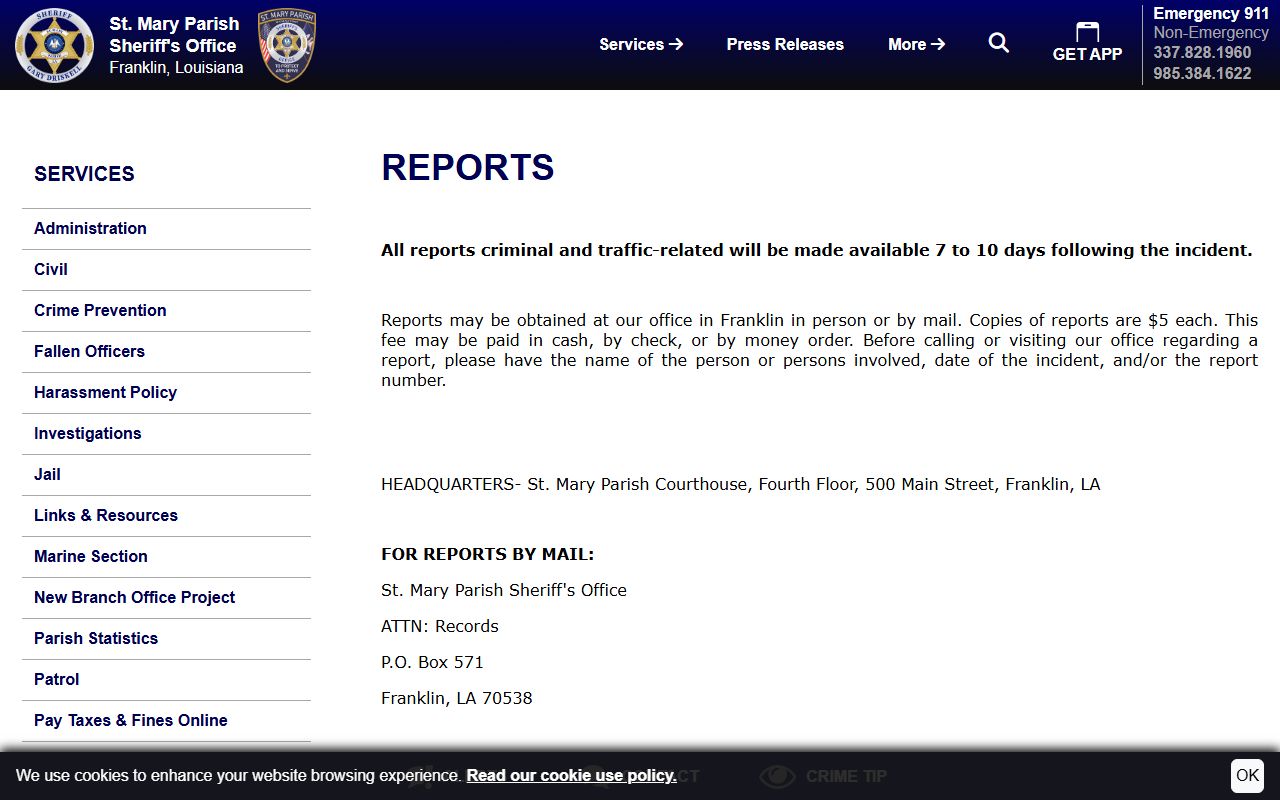
Those reports can help identify the incident date, involved names, and report number before checking whether the District Attorney filed court charges.
St. Mary Parish Charges After Arrest
In St. Mary Parish, the 16th Judicial District Attorney serves Iberia, St. Martin, and St. Mary Parishes. The official office directory lists St. Mary contacts for criminal prosecution and traffic, worthless checks, victim-witness assistance, diversion, probation, child support, and Adult Drug Court. That office is important because a booking charge is not the same as the charge that the prosecutor chooses to pursue in District Court.
The charging path can be simple or it can change. A person may be booked on one allegation and later face a reduced, amended, added, or dismissed charge. Some people are released on a summons rather than booked at the Law Enforcement Center. Others appear in the jail roster first, then later have docket history in Clerk eSearch. A court charge record is best read as a timeline, not as a single static label.
| Charging document | Who starts it | What it does in St. Mary Parish |
|---|---|---|
| Complaint | Law enforcement or prosecutor | States an accusation that can support early court action after an arrest or summons. |
| Bill of information | District Attorney | Common Louisiana prosecution filing used to place formal charges in the criminal case file. |
| Indictment | Grand jury | Used for serious charges when a grand jury returns the formal accusation. |
The 16th Judicial District Attorney budget publication page confirms the office as a current public agency source for the district that prosecutes St. Mary Parish charges.
District Attorney material is useful context for why a booking entry may later differ from the court charge shown in the Clerk's criminal docket history.
Find St. Mary Parish Arrest Records
A practical St. Mary Parish arrest records search checks several channels. The Sheriff's inmate roster covers current custody and recent releases. Clerk eSearch covers criminal index and docket history after a court case is released for online viewing. The District Attorney can explain prosecution divisions, but it is not a public case-search portal. The Sheriff's records section handles criminal and traffic incident reports by request.
- Start with the Sheriff's inmate roster if the person may be in current custody or recently released.
- Use Clerk eSearch for criminal index and docket history after formal court charges exist.
- Review whether the entry is only a booking charge, a filed charge, or a final disposition.
- Request the incident report from the Sheriff's records process when report facts are needed.
- Contact the Clerk for certified copies or pleadings because eSearch does not show criminal pleading images.
The Sheriff's payment page is also relevant when a charge or fine has moved into a payment posture. The Sheriff fine payment instructions say fines are not paid online through that sheriff page and describe in-person or arranged credit-card payment channels.
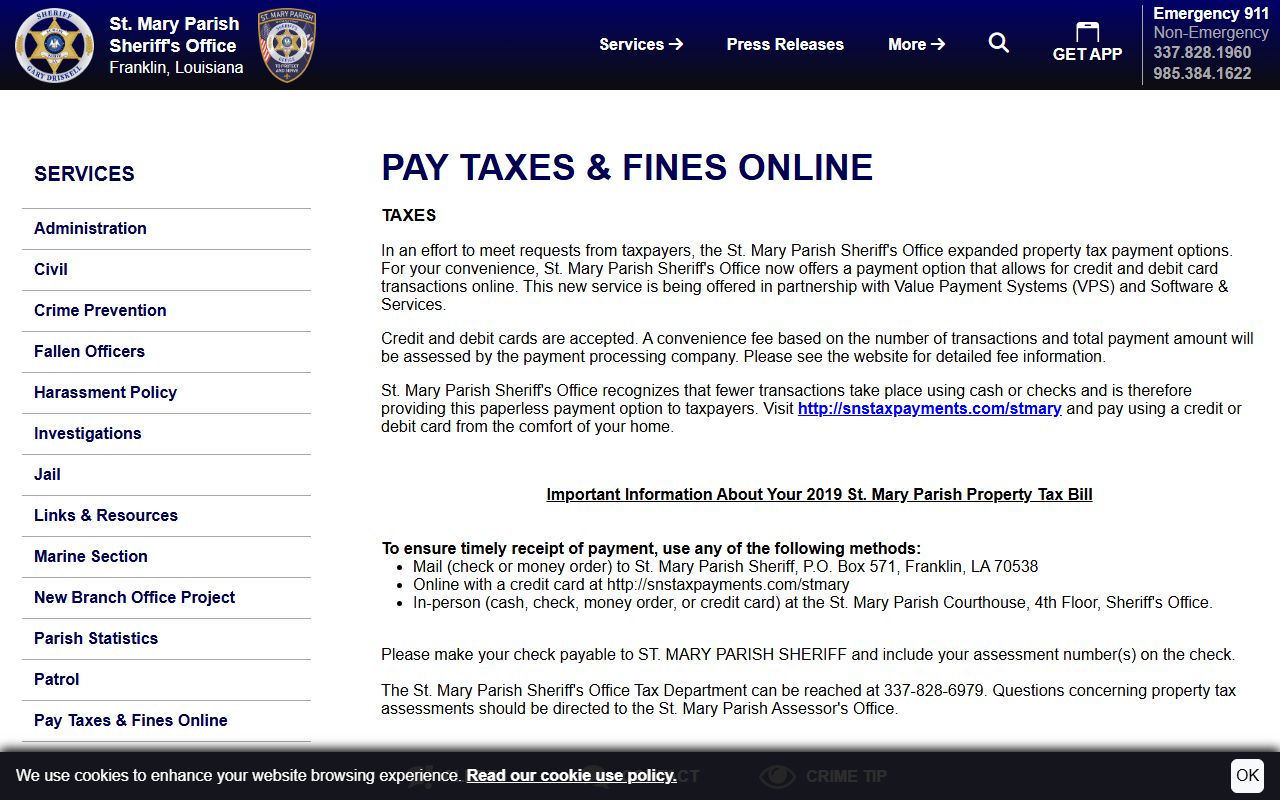
Fine-payment instructions should not be used as proof of a conviction, but they help locate the office channel once a court or agency directs payment.
St. Mary Parish Charge Status
Charge status is the point where many arrest records are misread. A booking entry can list an allegation from the arrest. The criminal court record may later show what was filed, amended, dismissed, or resolved. The word disposition means the final outcome of a charge or case. Until there is a plea, verdict, dismissal, or other final action, the charge is not a conviction.
| Status | Meaning | Where to verify |
|---|---|---|
| Pending | The charge is open and no final disposition is shown. | Clerk eSearch docket history or Clerk office copy. |
| Amended or reduced | The filed charge changed after prosecutor or court action. | Criminal docket entries and filed court documents. |
| Dismissed | The charge was ended by court action or prosecution decision. | Final minute entry, judgment, or disposition record. |
| Nolle prosequi | The prosecutor declined to continue that charge. | District Court criminal record or Clerk copy. |
| Conviction | A guilty plea or verdict produced a criminal judgment. | Final disposition and sentence entries. |
Note: If an online index is silent, it may mean the record is not released online yet, not that no case exists.
St. Mary Parish Charges vs Convictions
A charge is an accusation. A conviction is a final result after a plea or verdict. St. Mary Parish records can show both, but they should not be merged. The Sheriff's roster may list charges and bond while reminding readers that all persons are presumed innocent until proven guilty. The Clerk's criminal case history is the better place to check court actions, but certified copies still come from the Clerk's office.
| Point of comparison | Charge | Conviction |
|---|---|---|
| Record stage | Appears after arrest, summons, prosecutor filing, or court docket entry. | Appears after guilty plea, guilty verdict, or other conviction event. |
| Legal meaning | An accusation that still needs court action. | A final finding that can lead to sentence, probation, or other penalties. |
| Best local source | Sheriff roster for booking, Clerk eSearch for filed charges. | Clerk criminal docket history and certified court records. |
| Common mistake | Treating a listed charge as proof of guilt. | Assuming every arrest produced a conviction. |
Warrants and St. Mary Parish Charge Records
Warrants, summonses, and subpoenas can all appear near an arrest-to-charge record, but they do different work. The Sheriff's FAQ defines a warrant as a document issued and signed by a magistrate or judge and addressed to law enforcement. It can authorize arrest, search, or another justice action. A summons directs a person to appear. A subpoena orders a witness or other person to appear.
Failure-to-appear and warrant language may show up in arrest reports or inmate roster charges. A person trying to clear a warrant must return to the court that issued it, where a judge or magistrate decides what happens next. For active warrant checks, the St. Mary Parish warrant process is phone-based through the Sheriff's Warrants Division rather than a standalone public warrant database.
The Sheriff's most-wanted listing is not a full charge index. The Sheriff most-wanted disclaimer warns that public information can contain reporting or record errors.
Most-wanted material can help with public safety alerts, but court charge status still has to be checked through the court or issuing agency.
Restricted St. Mary Parish Arrest Records
Louisiana public-record law starts with access, but it does not make every charge public. Louisiana R.S. 44:1 defines public records and custodians. Louisiana R.S. 44:31 gives adults the general right to inspect, copy, or reproduce public records unless another law limits access. Louisiana R.S. 44:32 governs the custodian's duty and copy rules. Those laws work alongside court confidentiality rules.
Juvenile court records are restricted under Louisiana Children's Code article 412, except for traffic violations and authorized disclosures. That matters in St. Mary Parish because official 16th JDC material says Judge Vincent J. Borne presides over Juvenile Court in the parish. Adoption, sealed records, mental-health-related proceedings, minor identifying data, and protected personal identifiers should not be expected in ordinary public search results.
| Category | Public access effect | Local handling point |
|---|---|---|
| Juvenile matters | Generally confidential except traffic and authorized disclosures. | Court or attorney channel, not public lookup. |
| Sealed record | Hidden from ordinary public view by law or court order. | Confirm with Clerk or court order. |
| Expunged record | Removed from public access but not destroyed. | District Court filing and agency notice process. |
Sex Offender Registry Path
Sex offender registry information is not the same thing as an arrest record. It is a separate compliance and public-notice channel for people required to register. The St. Mary Parish Sheriff's sex offender page links to registry access and describes compliance work. The research also notes that the Sheriff's compliance section oversees registered offenders and handles complaints through a named local contact.
The St. Mary Parish Sheriff sex-offender page is the local route when registry status, not ordinary court charge status, is the issue.
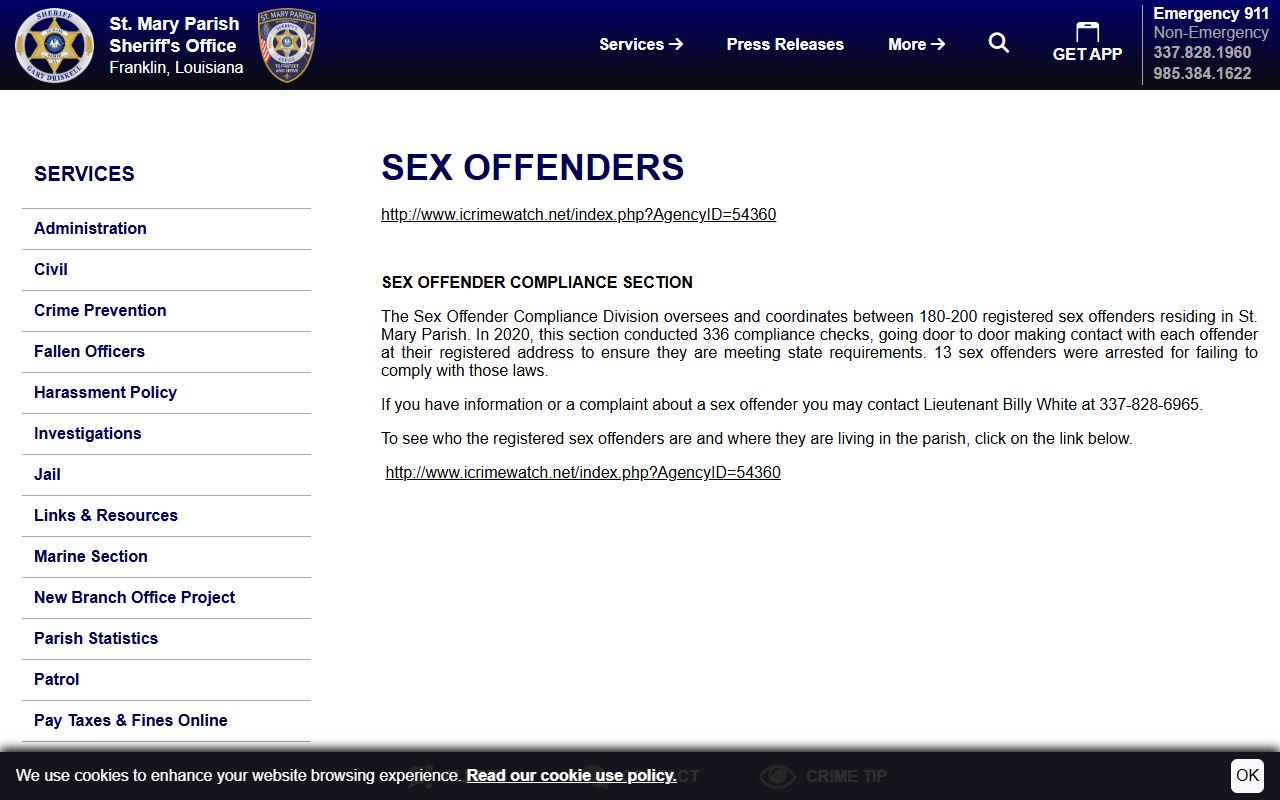
Registry information should be read as a compliance record, while the arrest and prosecution history must be checked through sheriff and court sources.
The Louisiana State Police sex offender registry access path supplies the statewide registry channel for Louisiana.

Using both local and statewide registry sources helps separate registry obligations from the criminal court charge record.